Jarrett Ransom Featured in The Major Gifts Report for Insights on Overcoming Donor Objections
Jarrett Ransom, Lead Senior Trainer at the Sanford Institute of Philanthropy, has been featured inThe Major Gifts Reportfor her insights on overcoming donor objections and strengthening donor relationships following her presentation at AFP ICON.
In the article, How to Transform Objections into Opportunities, written by Megan Venzin, Jarrett shares strategies for helping fundraising professionals reframe donor objections as opportunities for deeper engagement, stronger relationships, and greater trust.
Drawing on her experience working with nonprofit organizations and fundraising professionals, she discusses practical approaches for navigating donor concerns through active listening, empathy, and meaningful conversation. The article emphasizes the importance of understanding the motivations behind donor questions and using those moments to build stronger connections.
The feature also highlights principles from the Cause Selling approach, which helps fundraisers connect donors to mission-driven outcomes through authentic conversations and relationship-centered fundraising. By focusing on trust, shared purpose, and meaningful engagement, Cause Selling supports the development of long-term donor relationships.
The opportunity stemmed from Jarrett’s presentation at AFP ICON, where she shared strategies for addressing donor objections and advancing donor engagement. This feature highlights her expertise in donor-centered fundraising and relationship-building.
“Donor objections are often not roadblocks. They’re opportunities to better understand a donor’s perspective, build trust, and strengthen connections.”
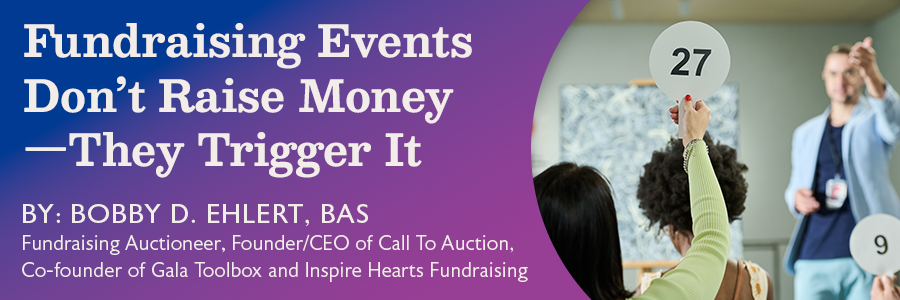
Fundraising Events Don’t Raise Money — They Trigger It
Written By: Bobby D. Ehlert, BAS, Fundraising Auctioneer, Founder/CEO Call To Auction, Co-Founder Gala Toolbox, Co-Founder Inspire Hearts Fundraising
Walk out of almost any gala, and you’ll hear the same question: “How much did we raise tonight?”
It sounds right. It feels right. But it misses what is really happening. Because the event didn’t raise money. The donor’s decision did.
At some point during the evening, a guest made a choice — to move from observer to participant…from attendee to donor…from “this is nice” to “this matters to me.”
That is the moment when fundraising happens. But it’s also something more. Because that decision doesn’t just create a gift. It has the potential to begin a lifelong relationship with your organization.
This is a core idea taught by Fundraising Academy: fundraising is not about transactions, it’s about transformation. It’s about relationships. The goal isn’t simply to raise money at an event — it’s to move someone from interest to belief, and from belief to long-term commitment.
When you design your event with that in mind, everything changes.
The Core Reframe: People Raise Money, Not Events
Events don’t give. People do.
Revenue is a byproduct of engagement and emotional connection. The event is simply the environment where those connections are formed, and decisions are made. And that decision is rarely isolated.
When someone gives in a meaningful way — when they feel connected and aligned with your mission — they are far more likely to give again. And again.
That’s why Fundraising Academy emphasizes building a donor pipeline, not just a successful event. Your gala should be one step in a larger journey — one that moves a guest toward deeper involvement over time.
So instead of asking, “How do we raise more money at our event?”
Start asking, “What kind of decision are we creating — and what happens after it?”
Because your job is not to produce an event. Your job is to produce belief and to create an experience that drives action.
Why Most Events Underperform
Many events look successful on the surface. They’re well attended and beautifully produced. But they underdeliver where it matters most: lasting donor engagement.
Why? Because most are built around logistics, not psychology.
Teams focus on décor, food, and auction items — but far less on the donor experience. The result is often a great party with fundraising added in, rather than an experience designed to inspire giving.
Common pitfalls include:
Too many silent auction items that dilute attention
Transactional bidding instead of emotional connection
Unclear or awkward fundraising moments
Guests attending, but not engaging
In short, many events are well produced — but poorly engineered for generosity. And when the experience doesn’t create connection, the result is predictable:
One-time gifts
Limited participation
Little momentum beyond the night
What This Looks Like in Action
Consider the evolution of Villa Montessori School.
Less than a decade ago, their event followed a familiar pattern — hundreds of silent auction items, modest attendance, and transactional giving. It raised around $50,000, but it wasn’t building a deeper connection with their community.
The shift began with a new goal: Not just raising more money — but building stronger believers.
The silent auction was scaled back. The focus moved to mission-aligned experiences. The program highlighted the people at the heart of the school — especially its teachers.
This year, the event was intentionally designed to honor and celebrate teachers, many of whom were in the room. Guests weren’t just supporting a school — they were connecting directly with the people shaping students’ lives.
That connection changed the room.
The fundraising approach evolved as well. A clear “Fund the Future” paddle raise gave donors a tangible understanding of their impact. The live auction featured community-built experiences, creating energy, pride, and ownership.
The results have been transformational. Over nine years, the event grew from $50,000 to over $250,000 annually. It now sells out every year, with broader participation and deeper engagement.
But the most important outcome isn’t the revenue. It’s that more people are saying, “I’m in.” And when they do, they’re far more likely to stay in.
The Triggers That Drive Lasting Giving
If the goal is not just a gift — but a relationship — then the experience must activate more than awareness.
Across high-performing events, several drivers consistently lead to continued giving:
Clarity of impact. Donors understand exactly what their gift will do.
Emotional connection. They feel aligned with the mission.
Simplicity. Giving feels easy and natural.
Social proof. They see others giving.
Momentum. The experience builds confidence and energy.
These elements reflect another principle emphasized by Fundraising Academy: donors need both inspiration and a clear path to action. When those come together, generosity becomes a natural response.
From Event Planning to Donor Journey Design
Most teams plan events by asking, “What needs to be included?” High-performing teams ask, “What journey are we inviting donors into?”
Because the event is not the finish line — it’s the entry point.
Think about the journey:
Arrival creates curiosity
The program builds connection
The fund-a-need invites action
Follow-up reinforces the relationship
Fundraising Academy often reinforces that the real work begins after the gift. Stewardship, communication, and continued engagement are what turn a first-time donor into a long-term supporter.
You’re not just running a program. You’re guiding someone toward becoming part of something bigger than themselves.
What This Means for Your Next Event
If your event is a trigger — not just a fundraiser — then your strategy must reflect that. Here’s how:
Design your paddle raise early, with clarity and intention.
Build your run of show around emotional flow, not just timing.
Activate your board and key supporters to model giving.
Measure participation and retention — not just dollars raised.
Because the goal isn’t just to raise money tonight. It’s to start relationships that last.
Closing Thoughts
The most effective fundraising events aren’t bigger. They’re more intentional. They recognize that the event itself is not the outcome — it’s the catalyst. Because in the end, fundraising doesn’t just happen because you hosted a gala. It happens because, at the right moment, you created the conditions for someone to say: “Yes. I’m in.”
And that decision doesn’t end when the night is over. It’s the beginning. Because when someone crosses that line — from attending to truly believing — they don’t just make a gift. They step into a relationship and become a partner in your mission.
That’s where the real potential lives.
Not on a single night — but in the lifetime of generosity that can follow. When you design your event to trigger that kind of decision, you’re not just raising money. You’re unlocking the full fundraising potential of a donor for years to come.
Author bio: Bobby D. Ehlert, BAS, currently leads a team of consultants and expert Fundraising Emcees and Auctioneers to help nonprofits transform their fundraising events from transactional to transformational. Together, they design and deliver customized solutions that engage, excite, and inspire giving. With 20+ years of experience and a belief that the world needs more Auctioneers, he is honored and committed to developing the next generation of Auctioneer talent.
Donor retention is what turns one-time generosity into a sustainable community of support. But across the sector, retention has hovered around 43%, and first-time donor retention can dip as low as 19%. Bloomerang’s Mission Retainable research — based on a November 2024 survey of more than 380 fundraisers and 1,000 donors — helps explain why donors drift and what you can learn from what high-retention organizations do differently.
Hidden Challenges in Donor Retention
Many retention problems do not show up as one big failure. They show up as small gaps between what donors want and what nonprofits consistently deliver.
1) Gratitude is different from ongoing connection. Fundraisers are strong at saying “thank you” — 97% report sending personalized thank-you notes. But donors stay when they see progress: 65% say regular updates about impact help them feel connected. A great thank you without follow-through can still end in a lapsed donor.
2) Transparency gaps quietly erode trust. Lack of transparency is a real reason donors stop giving (24%). Yet only 36% of nonprofits share regular impact reports. When donors cannot clearly see outcomes, uncertainty grows — and uncertainty breaks loyalty.
3) Donor fatigue is often a symptom of the experience. Nonprofits report donor fatigue as a major challenge (30%). Donors also reduce or stop giving because of financial limitations (87%). When budgets tighten, repeated asks without meaningful updates can feel exhausting even to mission-aligned supporters.
4) The “modern donor experience” gap is wider than many realize. Most nonprofits use a CRM (94%), but only 38% track first-time donor retention rates — meaning the crucial first-year journey can be hard to manage intentionally. Add channel and convenience mismatches (only 13% of fundraisers use text messaging even though it is donors’ third preferred channel; 24% of donors prefer digital wallets while only 47% of nonprofits offer them), and donors face friction at the exact moments you want momentum.
Effective Strategies to Build Lasting Donor Relationships
High-retention organizations consistently do three things well: personalize, communicate consistently, and build systems that support relationship-building.
Segment by relationship stage.
Start simple: first-time donors, recurring donors, and lapsed donors. Even basic segmentation helps you move from generic outreach to messages that match where someone is on their journey.
Make impact updates with a repeatable rhythm.
Donors say “clear results” is the number one activity that helps them feel connected (65%). Build a lightweight monthly format — one story, one metric, one photo — so updates do not depend on a huge lift from staff.
Make recurring giving the easy choice.
Recurring donors often give again because the mission matters (63%) and because they believe their donation is making a significant impact (50%). Make monthly giving highly visible on your donation form and show what a monthly gift sustains over time.
Thank quickly and personally.
Donors are 39% more likely to give again when thanked within 24–48 hours. Pair speed with sincerity: a brief call, a message that references what they care about, or a simple milestone note (“One year of support — thank you.”).
Ask, listen, and respond.
Only 14% of nonprofits use donor surveys, even though donors say feedback opportunities help them feel committed (23%). A short quarterly pulse survey can improve relevance and signal, “We’re building this with you.”
Case Study: Mara Elephant Project’s Retention Lift
The Mara Elephant Project shows how recurring giving and automation can strengthen retention. By focusing on monthly donations and sending consistent, automated updates about how contributions protected elephant habitats, they increased donor retention by 30%.
The takeaway is straightforward: reduce friction (automated monthly gifts) and reinforce meaning (reliable impact updates). Automation makes that consistency sustainable — even for small teams.
How Fundraising Tools Can Help
Mission Retainable is clear: technology is not the goal — connection is. But the right tools make connections easier to deliver, consistently.
Use your CRM as a retention engine.
Centralize giving history, preferences, and interactions, so personalization is practical. Track first-time retention explicitly and keep data clean, so messages reach the right people.
Automate what should not be optional.
Workflows can send acknowledgments, receipts, impact emails, and milestone celebrations automatically which will free staff time to focus on high-touch relationship building.
Use analytics (and AI) to focus limited time.
Predictive insights can flag donors at risk of lapsing, so you can intervene with a relevant update or a human touchpoint. Yet 32% of fundraisers do not use additional tools like AI, machine learning, or advanced analytics for donor engagement — an opportunity to prioritize outreach where it matters most.
Meet donors where they are.
Optimize forms for mobile and add digital wallets like Apple Pay and Google Pay. Consider text messaging for short impact updates, event reminders, or timely gratitude. Removing friction supports both first-time retention and recurring giving.
Retention is a Shared Mission
Retention is not about “holding on” to donors — it is about inviting them into partnership. When supporters feel valued, informed, and confident about their gift matters, they stay — and often deepen their involvement.
Author bio: Kirsten Wantland, a Certified Nonprofit Consultant with a Master’s in Nonprofit Management and Leadership, empowers nonprofits through strategic fundraising and data-driven decisions. Specializing in proactive, performance-boosting approaches, she champions systems that free fundraisers to focus on their mission. As part of Bloomerang, a cloud-based Giving Platform for nonprofits, Kirsten educates organizations on best practices for data storage, workflows, and donor cultivation to amplify fundraising success.
Cultivation with Intention: Turning First Impressions into Meaningful Relationships
Written By: Muhi Khwaja, MPA, CFRE, CFRM
In fundraising, every gift begins long before a proposal is ever written. It starts with a conversation, a moment of curiosity, and a relationship that is built with care. Intentional cultivation is not about moving a donor quickly toward a gift — it’s about moving them thoughtfully toward partnership.
The Cause Selling Cycle reminds us that fundraising is a relationship-driven, continuous process. When cultivation is practiced with purpose, fundraisers shift from transactional interactions to trust-based relationships that lead to long-term loyalty, not just one-time donations.
Industry leaders continue to emphasize this reality. BoardSource highlights that donor relationships mirror governance best practices — built on trust, transparency, and shared accountability. Similarly, the Association of Fundraising Professionals consistently reinforce that ethical, authentic relationship-building is the foundation of sustainable fundraising success.
Phase One: Connecting — Prospecting and Pre-Approach
The first phase of the Cause Selling Cycle — Prospecting and Pre-Approach — sets the foundation for intentional cultivation.
Prospecting is not about building the longest possible list of potential donors. It’s about identifying individuals whose values and philanthropic interests genuinely align with your mission. This requires a blend of data, intuition, and ethical screening. As noted by Grants Professionals Association, thoughtful prospect research is not about capacity — it’s about mission alignment and long-term partnership potential.
Pre-Approach is where preparation becomes a strategy. Before any first meeting, the fundraiser gathers insights: prior giving history, volunteer involvement, professional background, and personal interests. At this stage, cultivation becomes intentional because your outreach is informed rather than generic.
Done well, Pre-Approach ensures the donor feels recognized, not researched.
Phase Two: Exploring — Approach, Need Discovery, Presentation, and Handling Objections
This is where first impressions begin transforming into real relationships.
Approach is the initial meeting or interaction. The goal is not to impress with organizational achievements but to create a safe space for conversation. Fundraisers who succeed here are curious, authentic, and focused on learning rather than persuading.
Need Discovery is an ongoing process of listening. Donors are rarely motivated by statistics alone; they are driven by experiences, values, and deeply held beliefs. The more you understand what matters to them, the more natural the relationship evolves. The Association of Fundraising Professionals emphasizes that donor-centered listening is a hallmark of ethical fundraising.
During Presentation, the fundraiser connects the donor’s interests to specific organizational needs. This is not about giving a standard pitch deck. It is about storytelling — showing how the donor’s values and the organization’s mission intersect in a meaningful way.
Handling Objections is part of cultivation, not a failure of it. When a donor hesitates, says “not now,” or raises concerns, they offer valuable insight. These moments, when handled with empathy and transparency, deepen trust rather than weaken it. Objections show you where alignment still needs to grow.
Phase Three: Collaborating — The Ask and Stewardship
By the time you reach The Ask, cultivation has already done its primary work. The donor understands the mission, trusts the organization, and feels personally connected to the impact.
A strong ask is not a request made in isolation — it’s an invitation to invest in a shared vision. Because the relationship has been developed intentionally, the donor sees their role clearly and confidently.
Stewardship is where cultivation begins again.
Thank-you calls, handwritten notes, impact updates, site visits, and genuine expressions of gratitude are not “extras” — they are essential. BoardSource regularly underscores that stewardship is a governance and development function. When donors feel respected and informed, they become advocates, repeat givers, and ambassadors for your cause.
Intentional stewardship transforms a completed Cycle into the beginning of the next.
The Role of Trust in Intentional Cultivation
Nonprofit leadership communities consistently agree: trust is the true currency of philanthropy.
Across forums, from conference sessions hosted by the Association of Fundraising Professionals to best-practice discussions within Grants Professionals Association, the message is consistent: meaningful donor engagement happens when transparency, consistency, and integrity are present.
Intentional cultivation means fundraisers treat donor time, questions, and hesitations with respect. It means slowing down when needed and resisting the pressure to “close” too early.
The best fundraisers are not the fastest closers. They are the strongest relationship builders.
Fundraiser’s Reflection
To practice cultivation with intention: Prospect with purpose, not pressure. Look for alignment, not just capacity.
Prepare thoughtfully before every first interaction. Pre-Approach is where professionalism and personalization begin.
Practice curiosity over persuasion. In Approach and Need Discovery, your role is to learn, not to sell.
Welcome objections as clarity-builders.
They guide you toward deeper alignment and stronger trust.
Treat Stewardship as cultivation restarted. Every thank you is the beginning of the next chapter of the relationship.
Closing Thought
Intentional cultivation is what separates transactions from transformations. When fundraisers follow the Cause Selling Cycle with discipline and heart, first impressions do not fade — they deepen.
Because at its core, cultivation is not about moving donors through a process. It’s about walking beside them as partners in a mission that matters.
How Culture and Cause Selling Shape the Donor Journey
Written By: Jack Alotto, MA, CFRE
What is a Culture of Philanthropy?
A culture of philanthropy means everyone — board, staff, and volunteers — values relationships and fundraising, and all contribute to advancing the organization’s mission.
Fundraising and donor engagement are joint responsibilities, grounded in the principle that philanthropy is about building relationships and involves every staff member, not just the development team.
A true philanthropic culture prioritizes lasting relationships, gratitude, and alignment with the mission, encouraging generosity and shared purpose throughout the organization.
Two Key Elements of a Philanthropic Culture
Fundraising is not simply a function within the organization; it’s viewed as a central aspect of the organization’s mission. The commitment to fundraising permeates every level of the organization, reflecting its importance in sustaining and advancing the institution’s goals.
Gratitude
Gratitude is deeply embedded in the organization’s culture, extending far beyond the traditional thank-you notes. Appreciation is expressed consistently across all communications with donors, making it an integral part of the organization’s identity. This ongoing demonstration of gratitude ensures that donors feel valued and recognized for their contributions.
The organization honors its donors through genuine expressions of gratitude, meaningful recognition, and the sharing of impact stories. By highlighting the tangible effects of donors’ support, the organization fosters an environment that is welcoming and inclusive. This atmosphere encourages donors to continue their support and become repeat contributors.
Leadership
Leadership plays a pivotal role in modeling a culture of philanthropy. Leaders who actively participate in donor engagement and relationship-building efforts set the tone for the rest of the organization. Their involvement underscores the importance of philanthropy and reinforces the organization’s commitment to cultivating strong, lasting connections with donors.
How is a Culture of Philanthropy Embedded in the Donor Journey?
A culture of philanthropy transforms the donor journey from a series of fundraising tactics into a relationship-driven experience. It helps donors feel like partners in impact — deepening trust, increasing retention, and ultimately strengthening the sustainability of the organization.
Within the context of the Cause Selling Cycle, the donor journey unfolds through several interconnected stages:
Prospecting: The journey begins with the identification of individuals who may be interested in supporting the organization. A culture of philanthropy is enhanced when everyone is encouraged to suggest individuals who may be aligned with the organization’s mission, vision, and values. In organizations where boards, staff, and volunteers are invested in the mission, they can introduce you to high-value contacts in their networks. When asked, they may join you on the first visit with that new prospect.
In my own career, donor acquisition is often supported by board members, major gift donors, and volunteers identifying individuals in their networks who may share the organization’s mission, vision, and values. When boards, staff and volunteers are deeply invested in the mission, they become enthusiastic ambassadors who can introduce high-value contacts to the organization.
Empowering boards, staff and volunteers as mission-driven ambassadors of your work is a passionate extension of their belief in your mission and involvement with your organization.
Discovery: After prospects are identified, meetings are held to establish initial contact and begin building relationships. During these meetings, it is essential to understand and uncover the needs, interests, values, and motivations of each prospect. Donor discovery, in a culture of philanthropy, is a shared responsibility that treats donors as valued partners.
Presentation: The organization then shares its mission and cause, aligning its values and goals with those of the prospective donor. It is during this stage that we uncover and respond to any objections. During this stage, a philanthropic culture values the donor as a partner in impact, leading to communications that prioritize storytelling, gratitude, and results.
The Ask: Once a meaningful connection is established, a request for support is made. A philanthropic culture creates an environment beyond transactional fundraising, building a community where everyone feels ownership and understands giving as central to advancing the organization’s mission and work.
Stewardship: After a gift has been received, the organization ensures excellent stewardship by maintaining ongoing communication and appreciation for the donor’s contribution. A culture of philanthropy encourages personalized recognition, invitations to deeper involvement, and ongoing support for staff and board members to ensure effective relationship building and donor engagement.
Every stage of the donor journey in the Cause Selling Cycle focuses on relationship-building. This lays the foundation for a strong culture of philanthropy, which is instrumental in driving organizational achievements and furthering the overall mission. When philanthropy is embedded across the organization, donors feel valued, understood, and connected to the mission at every stage.
Key Takeaways
A strong culture of philanthropy strengthens organizations by boosting employee engagement, improving recruitment and retention, and enhancing financial performance, trust, and resilience. Staff, board members, and volunteers become active champions of the mission, leading to stronger fundraising outcomes such as higher donor retention, increased giving, and growth in major gifts. By breaking down silos, fostering shared responsibility and leadership engagement, and integrating the Cause Selling Cycle, nonprofits can create lasting donor relationships and a greater impact.
Try Our Free Intro Course!
FUN600 introduces Cause Selling fundamentals and core fundraising skills to help you start building a strong culture of philanthropy at your organization. Use code JAN26INTRO by December 31, 2026, to enroll at no cost! To learn more about the Cause Selling Cycle, sign up for our no-cost Online Learning Portal.